🟢 pp2 example from AUTO07p (aBD + Hopf aBS)
The goal of this example is to show how to use automatic bifurcation diagram computation for a simple ODE.
The following equations are a model of type predator-prey. The example is taken from Auto07p:
\[\begin{array}{l} u_{1}^{\prime}=3 u_{1}\left(1-u_{1}\right)-u_{1} u_{2}-p_1\left(1-e^{-5 u_{1}}\right) \\ u_{2}^{\prime}=-u_{2}+3 u_{1} u_{2} \end{array}\]
It is easy to encode the ODE as follows
using Revise, Plotsimport BifurcationKit as BKimport BifurcationKit: @optic#, @reset# function to record information from a solutionrecordFromSolution(x, p; k...) = (u1 = x[1], u2 = x[2])function pp2!(dz, z, p, t = 0) (;p1, p2, p3, p4) = p u1, u2 = z dz[1] = p2 * u1 * (1 - u1) - u1 * u2 - p1 * (1 - exp(-p3 * u1)) dz[2] = -u2 + p4 * u1 * u2 dzend# parameters of the modelpar_pp2 = (p1 = 1., p2 = 3., p3 = 5., p4 = 3.)# initial conditionz0 = zeros(2)# bifurcation problemprob = BK.ODEBifProblem(pp2!, z0, par_pp2, # specify the continuation parameter (@optic _.p1), record_from_solution = recordFromSolution)Automatic bifurcation diagram computation
We set up the options or the continuation
# continuation optionsopts_br = BK.ContinuationPar(p_min = 0.1, p_max = 1.0, dsmax = 0.01, # maximum number of continuation steps max_steps = 1000,)ContinuationPar{Float64, DefaultLS, DefaultEig{typeof(real)}}
ds: Float64 0.01
dsmin: Float64 0.0001
dsmax: Float64 0.01
a: Float64 0.5
p_min: Float64 0.1
p_max: Float64 1.0
max_steps: Int64 1000
newton_options: NewtonPar{Float64, DefaultLS, DefaultEig{typeof(real)}}
η: Float64 150.0
save_to_file: Bool false
save_sol_every_step: Int64 1
nev: Int64 3
save_eig_every_step: Int64 1
save_eigenvectors: Bool true
plot_every_step: Int64 10
tol_stability: Float64 1.0e-10
detect_fold: Bool true
detect_bifurcation: Int64 3
dsmin_bisection: Float64 1.0e-16
n_inversion: Int64 2
max_bisection_steps: Int64 25
tol_bisection_eigenvalue: Float64 1.0e-16
detect_event: Int64 0
tol_param_bisection_event: Float64 1.0e-16
detect_loop: Bool false
We are now ready to compute the diagram
diagram = BK.bifurcationdiagram(prob, BK.PALC(), # very important parameter. It specifies the maximum amount of recursion # when computing the bifurcation diagram. It means we allow computing branches of branches of branches # at most in the present case. 3, BK.ContinuationPar(opts_br; ds = -0.001, dsmax = 0.01, n_inversion = 8, detect_bifurcation = 3), )scene = plot(diagram; code = (), title="$(size(diagram)) branches", legend = false)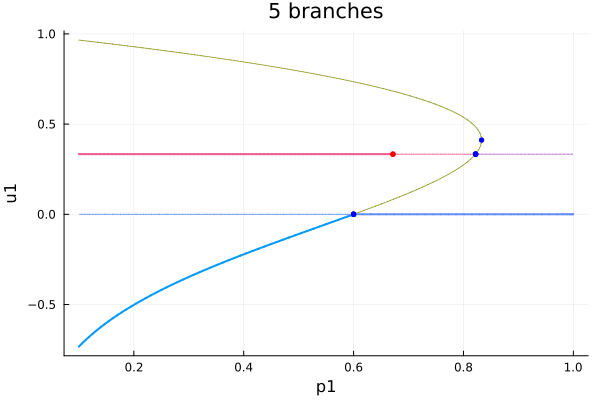
Branch of periodic orbits with collocation method
As you can see on the diagram, there is a Hopf bifurcation indicated by a red dot. Let us compute the periodic orbit branching from the Hopf point.
We first find the branch
# branch of the diagram with Hopf pointbrH = BK.get_branch(diagram, (2,2)).γ# continuation parametersopts_po_cont = BK.ContinuationPar(dsmax = 0.01, ds= 0.0001, dsmin = 1e-4, tol_stability = 1e-4, max_steps = 100, detect_bifurcation = 2)br_po = BK.continuation( brH, 1, opts_po_cont, BK.Collocation(20, 5); normC = BK.norminf)plot(diagram); plot!(br_po, branchlabel = "Periodic orbits", legend = :bottomright)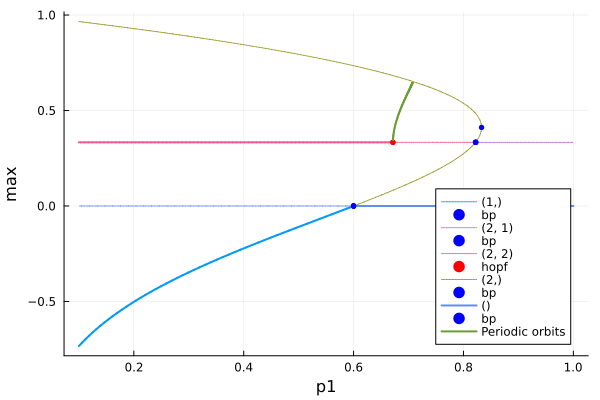
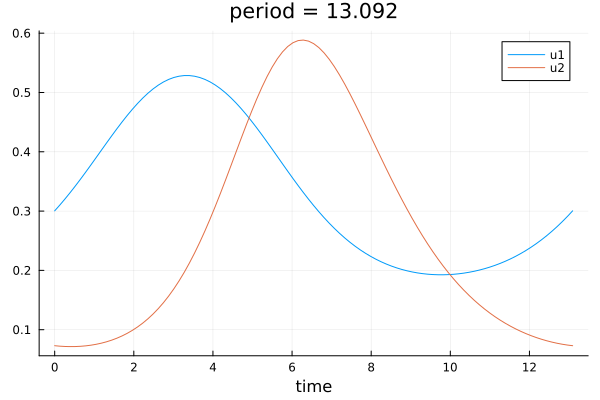
Let us now plot an orbit
# extract the different componentsorbit = BK.get_periodic_orbit(br_po, 30)plot(orbit.t, orbit[1,:]; label = "u1", markersize = 2)plot!(orbit.t, orbit[2,:]; label = "u2", xlabel = "time", title = "period = $(round(orbit.t[end], digits = 3))")